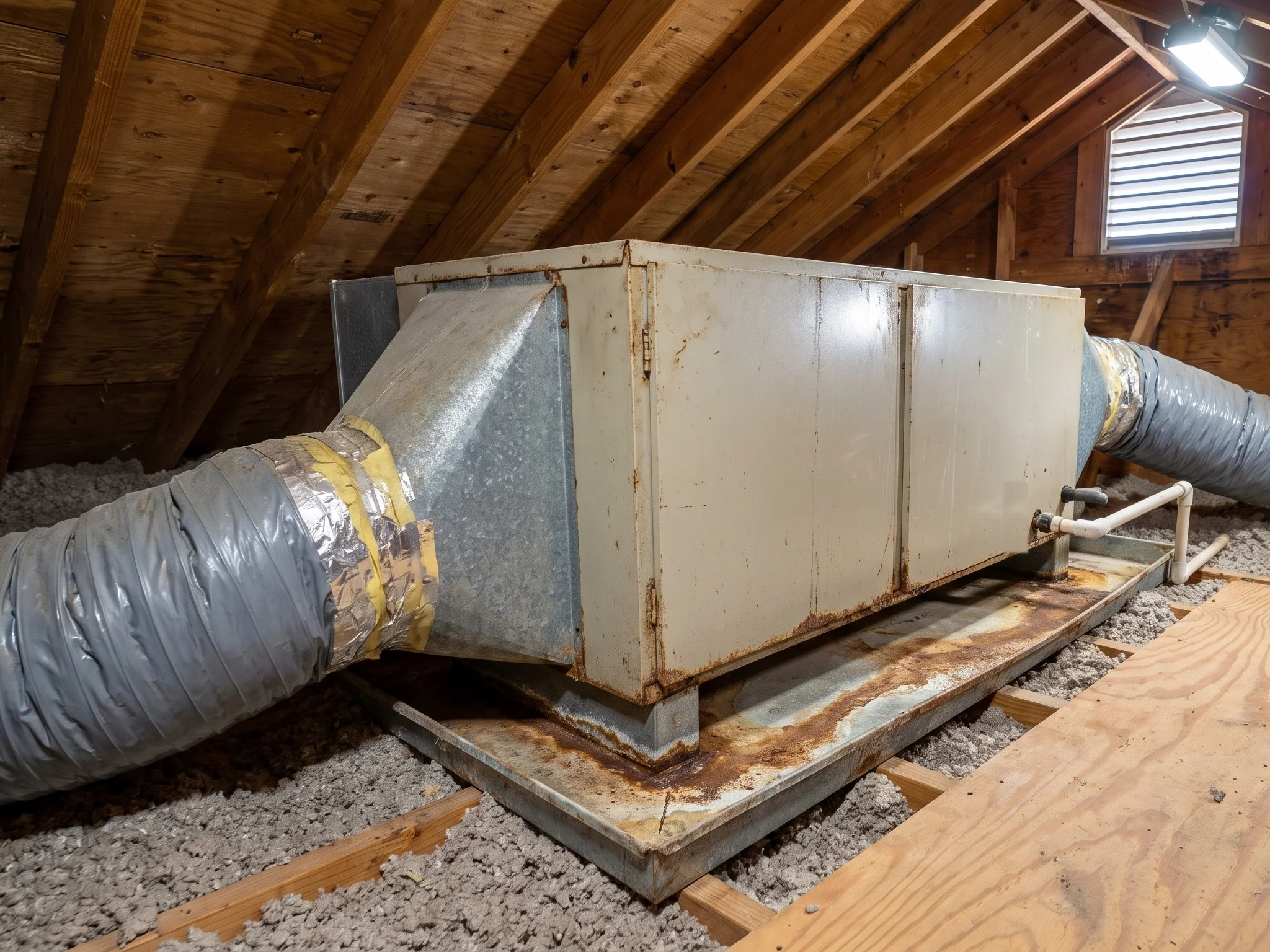
Published lifespans
The published studies and charts don’t agree on the exact year, but they land in the same range. The table lists each one with its date.
| Source | Central AC | Heat pump | Furnace |
|---|---|---|---|
| NAHB study (2007) | 10–15 years | 16 years | 15–20 years |
| InterNACHI life-expectancy chart | 7–15 years | 10–15 years | 15–25 years |
| Bluebonnet Electric Cooperative, Central Texas (December 2024) | 10–15 years | Not given | Not given |
| HomeGuide cost guides (2025) | 15–20 years | 10–15 years | Not given |
| Fixr central air guide (August 2025) | 10–20 years, 15 average | Not given | Not given |
ENERGY STAR suggests considering replacement once a heat pump or AC is more than 10 years old. ENERGY STAR also says a correctly installed high-efficiency unit can save up to 20 percent on heating and cooling costs.
How hard Austin works an AC
The National Weather Service Austin/San Antonio says normal highs reach 90 degrees by May 26 and stay above 90 until September 23. Austin averaged 29 days a year at 100 degrees or more over 1991 to 2020, and 2023 had 80 such days, second only to 2011’s 90. The 2023 total included a record 45 straight days from July 8 to August 21, and 2024 was Austin’s warmest year on record. HomeGuide says a compressor may last only 8 to 10 years in the southern U.S. because of heavier use.
Signs a system is near the end
Age alone doesn’t settle the decision, so look at these signs together:
- The system is past the published lifespan range for its type.
- It runs on R-22 refrigerant, which is no longer produced.
- It needs a repair every summer or a big repair involving a compressor, a coil, or a refrigerant leak.
- Rooms stay warm or the house feels humid even when the system runs constantly.
- Your electric bill climbs from one summer to the next with no change in how you use the house.
Repair or replace
CBS News explained in June 2026 that a common rule of thumb multiplies a system’s age by the repair cost and usually favors replacement when the result is above $5,000. The rule has no official source. HomeGuide and Angi use a 50% test that favors replacement when a repair costs half or more of a new unit.
We’d repair a capacitor or fan motor on a 6-year-old unit. For a 13-year-old unit with a failed compressor or coil, we’d replace the system.
Getting the most years from a new system
Change the filter on schedule and keep plants and grass clear of the outdoor unit. Have the system checked once a year, ideally before summer. Register the equipment with the manufacturer because Trane, for one, extends its parts warranty to 10 years when the unit is registered within 60 days of installation. A load calculation determines the size your house needs, and a system sized that way runs longer, steadier cycles that are easier on it than short bursts.
Lifespan questions
Do I have to replace an R-22 system?
No. The EPA says you can keep using R-22 in an existing system for as long as necessary, but recharging costs more each time. HomeGuide (August 2025) publishes a range of $180 to $600 for an R-22 recharge, so a leak usually ends it.
Is a 15-year-old AC worth repairing?
For a small part, often yes. For a compressor, a coil, or a refrigerant leak, usually not, because a 15-year-old AC is at the top of the 10-to-15-year range in the National Association of Home Builders (NAHB) study, and the repair spends money on equipment near the end of its life.
Sources
- NAHB and Bank of America Home Equity, “Study of Life Expectancy of Home Components”, February 2007
- InterNACHI, “InterNACHI's Standard Estimated Life Expectancy Chart for Homes”
- Bluebonnet Electric Cooperative, “How heat pumps got cool”, December 24, 2024
- HomeGuide, “How Much Does AC Replacement Cost?”, July 25, 2025
- HomeGuide, “How Much Does a Heat Pump Cost?”, October 30, 2025
- Fixr, “Cost to Install Central Air”, updated August 29, 2025
- ENERGY STAR, “When is it time to replace?”
- National Weather Service Austin/San Antonio, “Austin Climate Summary”
- National Weather Service Austin/San Antonio, “Austin area temperature rankings”, updated July 2026
- HomeGuide, “How Much Does an AC Compressor Cost?”, August 4, 2025
- CBS News, “What is the $5,000 rule for HVAC systems?”, June 24, 2026
- Angi, “Evaporator Coil Replacement Cost”, updated July 9, 2026
- Trane, “Trane Warranties: Types and Coverage Explained”, December 16, 2024
- U.S. EPA, “Residential Air Conditioning and the Phaseout of HCFC-22”, March 2020
- HomeGuide, “How Much Does a Home AC Recharge or Freon Refill Cost?”, August 18, 2025